
Menstrual Cycle Phases Explained: What Happens in Each One
Before I understood the phases of my cycle, the whole month felt random. Some weeks I had energy to spare, and other weeks I wanted to hide under a blanket, and I could not see the thread connecting them.
Learning the menstrual cycle phases changed that. The shifts suddenly had names and reasons behind them, and my body felt a lot less like a mystery I was failing to solve.
This is the plain version of what happens in each phase, the hormones driving them, and how the phases line up with your fertile days. Think of it as the background that makes everything else about tracking click into place.
Menstrual Cycle Phases at a Glance
Your cycle is counted from the first day of your period, which is day one, to the day before your next period begins. An average cycle runs about 28 days, though anywhere from roughly 21 to 35 days is common and healthy.
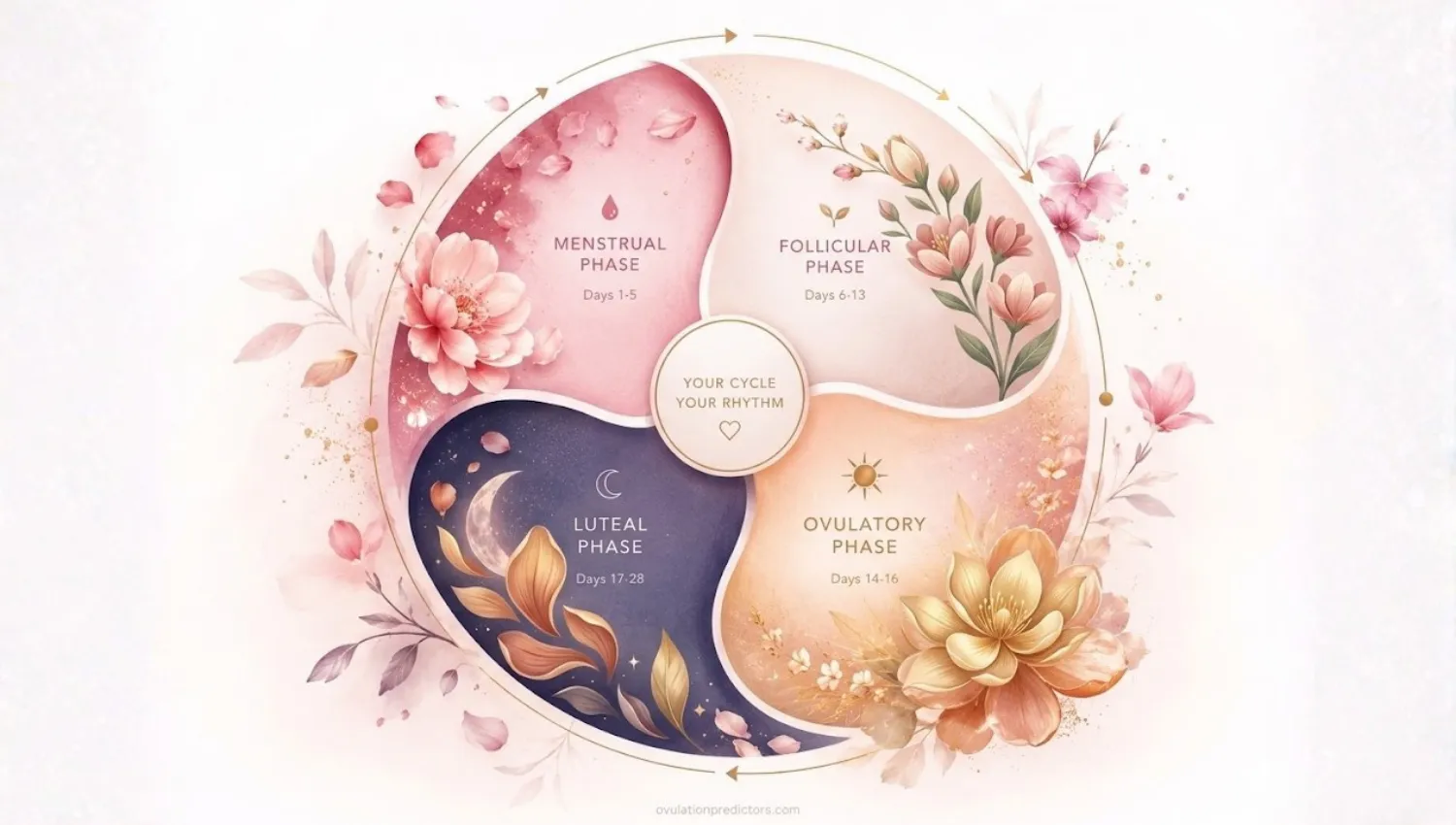
Most people describe four phases, though two of them are really events that sit inside the larger picture, so do not be surprised if you see them grouped differently elsewhere. Here is the quick map before we walk through each one.
| Phase | Days in a 28 day cycle | What is happening | How you might feel |
|---|---|---|---|
| Menstrual | Days 1 to 5 | The lining sheds as your period. | Lower energy, a pull toward rest. |
| Follicular | Days 1 to 13 | An egg matures and estrogen rises. | Energy and mood often lifting. |
| Ovulatory | Around day 14 | The egg is released. | Often a high point, more outgoing. |
| Luteal | Days 15 to 28 | The body prepares for a possible pregnancy. | Calm at first, then a dip late on. |

In order, the four phases are the menstrual phase, the follicular phase, the ovulatory phase, and the luteal phase, and then the cycle repeats. One thing worth clearing up early.
The follicular phase actually begins on the first day of your period, so it overlaps the menstrual phase at the start. And the day counts above slide later in a longer cycle, since it is mainly the follicular phase that stretches or shrinks, which is covered in more detail in ovulation by cycle length.
The menstrual phase
This is your period, and it marks day one of a new cycle. When pregnancy did not happen in the previous cycle, hormone levels fall, and the uterine lining that had built up sheds and leaves the body as your period.
Bleeding usually lasts somewhere between three and seven days. Estrogen and progesterone are at their lowest here, which is part of why many people feel lower on energy and want a slower pace. It is a reset, plain and simple.

The follicular phase
The follicular phase takes its name from the follicles, the small sacs in your ovaries, each holding an immature egg. A hormone called follicle stimulating hormone encourages several of them to grow, and usually one becomes dominant.
As that follicle develops, it pumps out estrogen, which steadily rebuilds the uterine lining and gets your body ready for a possible pregnancy. This phase runs from day one until ovulation, so it includes your period and then the buildup afterward.
Because its length varies from person to person and cycle to cycle, the follicular phase is the main reason cycle lengths differ.

The ovulatory phase
Rising estrogen eventually triggers a sharp surge of luteinizing hormone, and that surge is what makes the dominant follicle release its egg. That release is ovulation, and it usually happens about 14 days before your next period starts.
The ovulatory phase is short, just a window of a day or two around the release, but it is the headline event of the whole cycle and the center of your fertile days. If you want to recognize when it is happening for you, the live clues are covered in the guide on signs of ovulation.

The luteal phase
After the egg is released, the empty follicle transforms into a structure called the corpus luteum, which produces progesterone. Progesterone is the hormone of the second half of your cycle, the stretch also known as the two week wait. It keeps the uterine lining thick and steady in case a fertilized egg arrives to implant.
If pregnancy does not happen, the corpus luteum breaks down, progesterone drops, and that fall in hormones brings on your next period, which starts the cycle over again.
The luteal phase tends to stay fairly constant, usually around 12 to 14 days, which is exactly why ovulation can be estimated by counting back from your expected period, the full logic behind how ovulation is calculated.

The hormones behind the phases
Four hormones do most of the work, rising and falling in a steady relay. You do not need to memorize them, but seeing how they hand off to each other makes the phases make sense.
| Hormone | What it does | When it is highest |
|---|---|---|
| Follicle stimulating hormone | Prompts follicles to grow. | Early in the follicular phase. |
| Estrogen | Rebuilds the uterine lining and triggers the LH surge. | Just before ovulation. |
| Luteinizing hormone | Surges to trigger the release of the egg. | Right before ovulation. |
| Progesterone | Maintains the lining after ovulation. | The middle of the luteal phase. |

How the phases connect to your fertile window
Once the phases are clear, fertility stops being mysterious. You can only get pregnant in the run up to ovulation and on ovulation day, so your fertile window lives at the boundary between the follicular and ovulatory phases. The luteal phase, by contrast, is not fertile, because the egg has already come and gone.
If you want to see where that window falls in your own cycle, you can find your fertile window with the calculator and watch it land right where the phases predict.

Why this helped me
Mapping my own days onto these phases made tracking feel intuitive instead of like homework. When I know I am in my follicular phase, I know my fertile window is coming. When I am clearly in my luteal phase, I know my period is on the way. The names did the heavy lifting.
Do the phases match how you feel?
For a lot of people, yes, at least loosely. As estrogen climbs through the follicular phase and peaks around ovulation, many notice more energy, a brighter mood, and a higher sex drive. In the later luteal phase, as progesterone falls, premenstrual feelings can show up, things like low mood, bloating, or cravings.
That said, this varies enormously from person to person, and plenty of people do not follow the textbook pattern at all. Treat it as a gentle guide to your own rhythm, not a rule you are supposed to fit.
Questions people ask me about cycle phases
How many phases does the menstrual cycle have?
Most descriptions use four: the menstrual, follicular, ovulatory, and luteal phases. The menstrual phase and ovulation are sometimes treated as events within the two larger phases, which is why you may see the cycle split into just two main phases elsewhere.
What is the difference between the follicular and luteal phase?
The follicular phase comes before ovulation, when an egg matures and estrogen rises. The luteal phase comes after ovulation, when progesterone rises to prepare the lining. The follicular phase varies in length, while the luteal phase stays fairly steady.
Which phase is the most fertile?
The fertile days fall at the end of the follicular phase and into ovulation, which is the ovulatory phase. The luteal phase that follows is not fertile, since the egg is no longer available.
How long does each phase last?
On an average cycle, the period lasts about three to seven days, the follicular phase runs from day one to roughly day 13, ovulation happens around day 14, and the luteal phase fills the last 12 to 14 days. These shift with your own cycle length.
What hormones control the menstrual cycle?
Mainly four. Follicle stimulating hormone and estrogen lead the first half, a surge of luteinizing hormone triggers ovulation, and progesterone runs the second half until it drops and your period begins.
Can the phases change length?
Yes, mostly the follicular phase, which is why your overall cycle length can vary. The luteal phase is usually more constant. Stress, travel, and health changes can all nudge the timing.
Is the menstrual cycle 3 phases or 4?
Both descriptions are used, and neither is wrong.
The four phase version, used throughout this guide, splits things into menstrual, follicular, ovulatory, and luteal.
A three phase version sometimes treats the menstrual phase as part of the follicular phase instead, since they overlap at the start, leaving just follicular, ovulatory, and luteal. It is the same underlying biology described with a slightly different grouping.

About Emma Bennett
I am a blogger, not a doctor or a health professional. I track my own cycle with Luna and I write from that everyday experience plus general information I check against trusted health sources. On a topic like avoiding pregnancy I would always rather be honest about the limits than make tracking sound more certain than it is.
Please read: This article and the Luna ovulation calculator are for general education and personal cycle tracking. They offer estimates, not medical advice, and they are not a reliable method of contraception. Everyone’s body is different, and many things can affect ovulation. For fertility concerns, irregular or sudden changes in your cycle, or any personal health question, please speak with a qualified healthcare provider.
Sources I leaned on
Since I am not a clinician, I cross checked the general facts here against well regarded health organizations. These are good places to read further:


